"Filled with rich detail and lovable characters . . . Wieland finds something fascinating and engrossing in every twist of the tale.
A strange, beautiful, and unexpected exploration of the fallout of family tragedy."
Kirkus Reviews (starred review)
“By turns comic and tragic, Mitch Wieland’s The Ghosts of Okuma is a sharply-written and brilliantly-paced novel . . . Funny, charming, infused with tenderness—a pure pleasure to read.”
Anthony Doerr, winner of the Pulitzer Prize
"Mitch Wieland, always an original, has found unaccustomed depth in the teen romance that frames a father's search for a runaway child, and achieved a remarkable blend of American and Japanese modes of storytelling."
Madison Smartt Bell, finalist for the National Book Award
“Powerful, and at times playful, The Ghosts of Okuma suggests that our vulnerabilities are a beginning, rather than an end, once we remove our masks.”
Ann Beattie, American Academy of Arts and Letters Award
“The Ghosts of Okuma is the story of a quest, a brother’s devotion and a son’s cherished duty, but it is mainly a poem to the kind of innocent passion life only offers once. To turn away from this story of hope and grief and adventure, by one of our most talented writers, you would have to have a heart of stone.”
Jacquelyn Mitchard, #1 New York Times bestselling author
“Wieland’s haunted teen-aged lovers are both wildly funny and pierced by yearnings everyone in our crumbling world will recognize.”
Andrea Barrett, winner of the National Book Award
“This novel is a wild ride, and it leaves you breathless."
Charles Baxter, finalist for the National Book Award
“Mitch Wieland’s vivid, unsparing prose conjures a Tokyo of snow and light, loss and belonging. Reminiscent of Kobo Abe’s The Ruined Map and Ruth Ozeki’s A Tale For The Time Being, this haunting story lingers like frostbite—quietly transformative, achingly real, and unforgettable.”
Jake Adelstein, author of Tokyo Vice
“I loved this book. Part mystery, part coming of age, part quest story of a stranger in a strange land, this stark and lyric tale resonates as coolly and beautifully and darkly as the temple bell at Chion-In. What happens when Wyatt and his father—and, in a way, his mother too—seek their missing sister and daughter in Japan is haunting in ways that last, and matter. Read this book.”
Bret Lott, author of Jewel, an Oprah Book Club selection
“The novel's quirky heroine is both tour guide to an underside of Tokyo and a savant capable of unbraiding human emotion. Tragic and empowering, The Ghosts of Okuma delivers on multiple levels, as rare as a perfectly executed snow angel following a winter dusting.”
Ridley Pearson, #1 New York Times bestselling author
“A feat of storytelling, at once a mystery, a love story and a clear-eyed meditation on the human condition. Mitch Wieland has written a novel that is vibrant, lyrical and devastatingly true.”
Brady Udall, author of The Miracle Life of Edgar Mint
“A broken family tries to piece itself back together on a wild journey that takes us from California to the neon-lit maze of Tokyo to the irradiated wasteland of Fukushima. The Ghosts of Okuma is a story of healing told with quirky humor, compelling mystery, and moving insight into the human heart.”
Benjamin Percy, author of Red Moon
“The Ghosts of Okuma is a love story, a quest, and a psychedelic trip into haunting realms that turn out to be spectacularly real. In the shadow of suicide and nuclear catastrophe, our teenage hero, Wyatt, along with the unforgettable Yoshimi, navigate a labyrinth of pulsing streets, underground music scenes, love hotels, and exclusion zones. Mitch Wieland has built a world of neon and fog; love and loss; devastation and, ultimately, transcendence.”
Anna Caritj, author of Leda and the Swan
“From the authenticity of the characters to the wonderment and beautiful intricacies of the world around them, we’re transformed by the ride. Heroes like this impact us far beyond the back cover.”
Marion Dayre, screenwriter for Better Call Saul
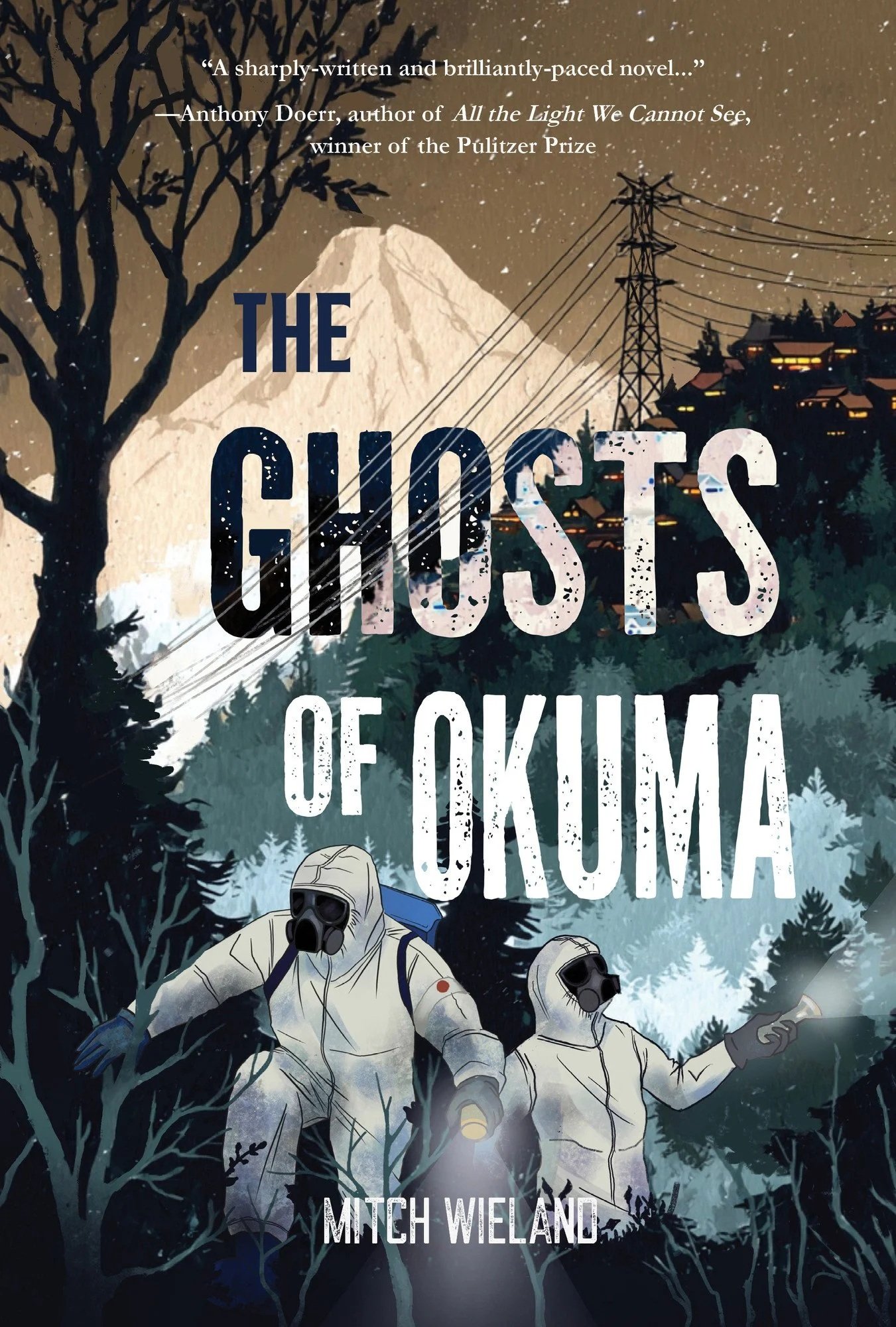
EARLY PRAISE for The GHOSTS OF OKUMA
praise for GOD’S DOGS
“Mitch Wieland’s stories are like his characters: wind-swept, isolated, trembling with longing. God’s Dogs is about the pinioning of the invisible against the visible, about the way something unrestrained and deeply meaningful smolders beneath the surface of what at first looks very composed. This is a powerful, lonesome, beautifully-written collection.”
Anthony Doerr
“Mitch Wieland, one of our country’s best magazine editors, shows where he gets his know-how—he’s a keen creator of fine stories, and makes characters out of sentences all of us should envy, and ties his characters to this land of ours with a knot you couldn’t cut with a sword—”a lone coyote calls from the ravine . . . I’m here, it asks, anyone else?” I am. You’ll want to be.”
Alan Cheuse
“Fastidious, trenchant, spare and often eloquent, Mitch Wieland’s stories have great breadth, powerful sympathies and a renewing comprehension of our human selves which we only find in the best literature.”
Richard Ford
“Mr. Wieland’s is a book bigger than its well-fit parts, a book that rouses and reaches for more than the expected, a book that gets our crooked kind right, a book that shakes the dickens out of the heart, a book which offers Big Answers to Big Questions, and a book that reminds you what a miracle it is that perdurable art—the art that matters to the species—is made out of words and words alone.”
Lee K. Abbott
“Mitch Wieland writes with fearless wonder, a piercing sense of loss, and the resilient grace of humor. Rilla and Ferrell and all their miraculous companions will break your heart a hundred times, and a hundred times restore you. Reading God’s Dogs is pure joy, a reminder all life is love, and love alone sustains us.”
Melanie Rae Thon
“With a keen divinitation of the deepest emotions, Mitch Wieland has found a mythological dimension in this accidental community of self-isolating loners in the vast (but hardly empty) spaces of Idaho.”
Madison Smartt Bell
“Mitch Wieland’s God’s Dogs is an artfully turned sequence of related stories that add up to a powerful novel. I am reminded of Faulkner’s Go Down, Moses. This novel is beautifully paced and brilliantly written. Its recurrent imagery, principally deriving from coyotes and wild mustangs and hawks, complements the lives of the leading characters, especially the protagonist, Ferrell Swan, a curmudgeonly retired teacher of history from Ohio who is now ranching and roiling in Idaho. The other figures in this small cast, especially Rilla, Ferrell’s ex-wife, are strikingly memorable. The action unfolds against the dazzling panoramic setting of the barren but spectacular landscape. You can taste the grit of the earth and feel the rising heat of the day and the chill of the night. A novel well worth rereading. I salute its maker.”
George Core, Editor, The Sewanee Review
“Edgy, long-suffering, self-flagellating, tender as the arch of a newborn’s foot, tough as salted jerky—Ferrell Swan saws his way through his so-called retirement with the determination of a man who insists on being true to his nature, despite the opposition of nearly everyone and everything else in his life. No one knows the truth of that saying, “The heart never fits its longing,” more intimately than Mitch Wieland. This is a powerful and beautifully written collection.”
Brad Watson
“From its bold cover art to its daring storyline; distinct writing style to its well-honed sense of place, God’s Dogs, Wieland’s latest novel, is the best piece of literature I’ve read in 2009. Each chapter reads as a short story, and collected tell the panoramic story of Ferrel Swan—a retired, Midwest school teacher seeking solitude in Idaho’s high desert—his ex-wife/later-in-life lover, and delinquent son.”
Ross Wulf, Rediscovered Bookshop

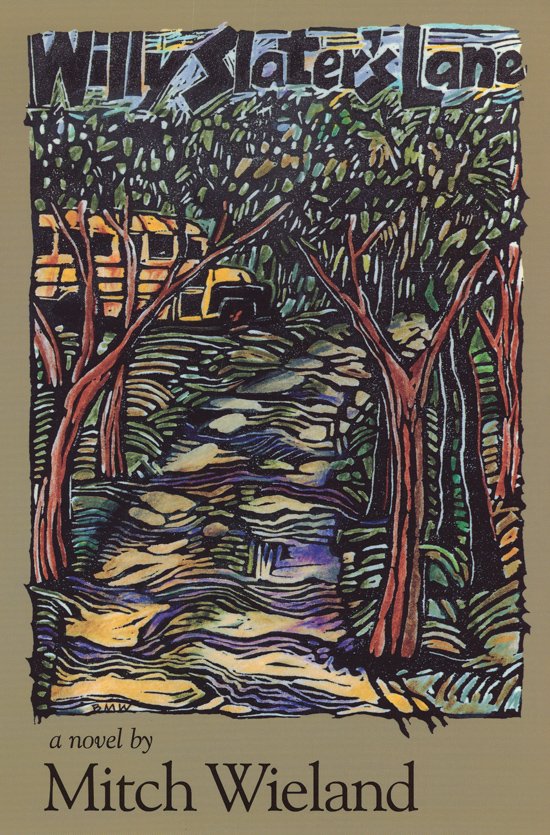
praise for WILLY SLATER’S LANE
“Wieland’s lovely first novel is likely to entrance readers with the sheer quixotic wonder of his telling of quenched lives . . . Through the brevity born of perfectly chosen words, and through the pervasive intimations of hope, Wieland transforms this story of lives on the edge of ordinary into a psalm.”
Publisher’s Weekly (starred review)
“This small gem of a book offers a transcendent portrait of two eccentric, middle-aged brothers who could have come straight from the pages of a Sherwood Anderson novel . . . First-novelist Wieland is a meticulous craftsman, using spare, quiet sentences to compose this spellbinding character study.”
Booklist (starred review)
“Willy Slater’s Lane, with its simple plot and simple language, is immensely moving, reminding us that the story that seems the tritest can still turn out to be the truest.”
New York Times Book Review
“Charming, upbeat first novel set in Ohio . . . A modest mixture of Sherwood Anderson and Erskine Caldwell, with some perfectly observed characters in a narrative that is winningly sweet without being sentimental.”
Kirkus Review
“Mitch Wieland’s Willy Slater’s Lane is grand entertainment.”
Fort Worth Star-Telegram
“Willy Slater’s Lane is touching and funny and life-affirming.”
San Antonio Express News
“Wieland gives his readers a lovely tale of survival and belief in humanity, allowing Erban to become a sort of rural angel throughout the end of the novel.”
Dan Wickett, Emerging Writer’s Network (Five Stars)
“An elegantly written, strangely absorbing contemplative novel, fascinating to read. Willy Slater’s Lane can be placed in the impressive tradition of classics like Anderson’s Winesburg, Ohio.”
Madison Smartt Bell
“This novel is a carol. It offers a clear view, a lucid interval. It shows once more that the way out is the way in . . . . This is a wonderful novel.”
Mary Hood
“Willy Slater’s Lane has the potential to become a small classic on the order of Saul Bellow’s Seize the Day.”
Gordon Weaver
“This is a novel that will establish Mitch Wieland as a unique and significant voice in American Fiction.”
Allen Wier
“Willy Slater’s Lane is a vivid, haunting book that tells a parable of our time. Mitch Wieland is a natural storyteller. His sense of the commonplace macabre is reminiscent of Sherwood Anderson, as is his wise, quiet, and remarkably graceful style.”
John Keeble