
NOVELS

GOD’S DOGS
A Novel in Stories
Ferrell Swan has fled the shambles of his life for the vast and empty landscape of Idaho’s high desert. Here, Swan strives to escape that past and its failures—even to escape memory itself. He seeks solace in sunrises and sunsets, wild mustangs and wheeling hawks, and the coyotes that roam his one hundred acres of scrub land. Through visits from his stepson and his ex-wife, through occasional contacts with odd and reclusive neighbors, Swan confronts himself in order to realize his humanity.
Recognition for God’s Dogs:
Idaho Book of the Year
Finalist John Gardner Book Award
Named a Best Book of the Year by New West
Featured in Best of the West prize anthology
Nominated for Pacific Northwest Booksellers Award
Read a story from God’s Dogs in The Kenyon Review.
-
“These tales of Western isolation, male muteness, and extreme physicality—tales of earth and blood but also of ghosts and gods—are crafted with a restraint and accuracy that matches early Thomas McGuane and Richard Ford . . . . Wieland builds prose with “zero at the bone,” and his eye roves the territory with an uncommon lucidity, an artless poeticism.”
William Giraldi, American Book Review
Wieland’s unsung genius is his rendering of family . . . Over the passionately carved and carefully polished course of God’s Dogs, the love of family is revealed to be not so much unconditional as it is inescapable.
Fiction Writers Review
A complicated pleasure as all good fiction must be, to be cast out there with Ferrell and Rilla and the rest as so many big questions are dealt with: How do we love? How do we share who we are? What do we run from? Who do we run to? Where do we belong? Where is home?
Boise Weekly
A unique and robust meditation on the ways love and land sustain us.
Idaho Librarian
Sharp prose with the pleasing density of language . . . Wieland works with elemental themes, the desert isolation of Ferrell’s cabin in some ways serving as a stage set to show what goes on between one man and one woman when all other distractions are taken away . . . As Ferrell, the would-be hermit learns in the accomplished God’s Dogs, dreams can be difficult to realize, and even their realization can leave one feeling hollow.
New West
With its stunning vistas and harsh climate, the Owyhee Desert in Southwest Idaho can seem a mythical place. In Mitch Wieland’s well-received new novel, God’s Dogs,, the Owyhee Desert also is a place of transparence, where complex emotions are laid bare under the heat of a blazing sun.
Explore
-
Mitch Wieland’s stories are like his characters: wind-swept, isolated, trembling with longing. God’s Dogs is about the pinioning of the invisible against the visible, about the way something unrestrained and deeply meaningful smolders beneath the surface of what at first looks very composed. This is a powerful, lonesome, beautifully-written collection.
Anthony Doerr
Mitch Wieland, one of our country’s best magazine editors, shows where he gets his know-how—he’s a keen creator of fine stories, and makes characters out of sentences all of us should envy, and ties his characters to this land of ours with a knot you couldn’t cut with a sword—”a lone coyote calls from the ravine . . . I’m here, it asks, anyone else?” I am. You’ll want to be.
Alan Cheuse
Fastidious, trenchant, spare and often eloquent, Mitch Wieland’s stories have great breadth, powerful sympathies and a renewing comprehension of our human selves which we only find in the best literature.
Richard Ford
Mr. Wieland’s is a book bigger than its well-fit parts, a book that rouses and reaches for more than the expected, a book that gets our crooked kind right, a book that shakes the dickens out of the heart, a book which offers Big Answers to Big Questions, and a book that reminds you what a miracle it is that perdurable art—the art that matters to the species—is made out of words and words alone.
Lee K. Abbott
Mitch Wieland writes with fearless wonder, a piercing sense of loss, and the resilient grace of humor. Rilla and Ferrell and all their miraculous companions will break your heart a hundred times, and a hundred times restore you. Reading God’s Dogs is pure joy, a reminder all life is love, and love alone sustains us.
Melanie Rae Thon
With a keen divinitation of the deepest emotions, Mitch Wieland has found a mythological dimension in this accidental community of self-isolating loners in the vast (but hardly empty) spaces of Idaho.
Madison Smartt Bell
Mitch Wieland’s God’s Dogs is an artfully turned sequence of related stories that add up to a powerful novel. I am reminded of Faulkner’s Go Down, Moses. This novel is beautifully paced and brilliantly written. Its recurrent imagery, principally deriving from coyotes and wild mustangs and hawks, complements the lives of the leading characters, especially the protagonist, Ferrell Swan, a curmudgeonly retired teacher of history from Ohio who is now ranching and roiling in Idaho. The other figures in this small cast, especially Rilla, Ferrell’s ex-wife, are strikingly memorable. The action unfolds against the dazzling panoramic setting of the barren but spectacular landscape. You can taste the grit of the earth and feel the rising heat of the day and the chill of the night. A novel well worth rereading. I salute its maker.
George Core, Editor, Sewanee Review
Edgy, long-suffering, self-flagellating, tender as the arch of a newborn’s foot, tough as salted jerky—Ferrell Swan saws his way through his so-called retirement with the determination of a man who insists on being true to his nature, despite the opposition of nearly everyone and everything else in his life. No one knows the truth of that saying, “The heart never fits its longing,” more intimately than Mitch Wieland. This is a powerful and beautifully written collection.
Brad Watson
From its bold cover art to its daring storyline; distinct writing style to its well-honed sense of place, God’s Dogs, Wieland’s latest novel, is the best piece of literature I’ve read in 2009. Each chapter reads as a short story, and collected tell the panoramic story of Ferrel Swan—a retired, Midwest school teacher seeking solitude in Idaho’s high desert—his ex-wife/later-in-life lover, and delinquent son.
Ross Wulf, Rediscovered Bookshop Bookseller
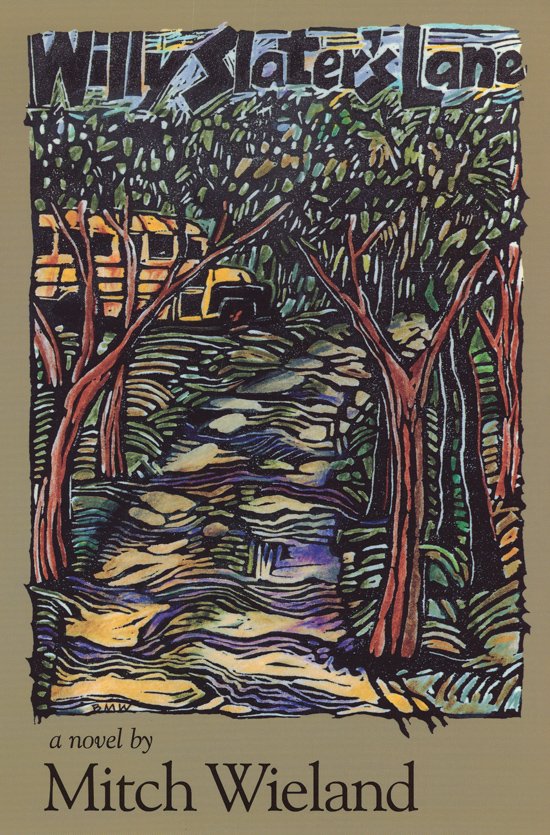
Willy Slater’s Lane
Debut Novel
The eccentric middle-aged Kern brothers have lived out their lives on an isolated backroad in rural Ohio, an area being surrounded by a strip-mining operation. The elder brother Harlan’s mistrust of the outside world has led them to sell most of their inherited farmland and live like hermits. Most of the novel concerns the bizarre sloth of the brothers’ routine— they haven’t worked since their parents died of food poisoning years before; when the living room of their house collapses into a sinkhole, they move into the kitchen; when the whole house falls into the pit, they move into a derelict school bus in the front yard. The focus of the narrative is on the essential difference in character between the brothers. With his venom, Harlan has driven away his long-suffering yet irascible mail-order bride. The younger brother, Erban, who had tried to intervene when Harlan refused to help his wife as she lay seriously ill, nonetheless remains loyal to his sibling in spite of many abuses, and comes to seem in his sweet-natured simplicity a kind of back-country saint.
Through the brevity born of perfectly chosen words, and through the pervasive intimations of hope, Wieland transforms this story of lives on the edge of ordinary into a psalm.
Publishers Weekly (starred review)
Immensely moving, reminding us that the story that seems the tritest can still turn out to be the truest.
The New York Times Book Review
-
This small gem of a book offers a transcendent portrait . . . Wieland is a meticulous craftsman using spare, quiet sentences to compose this spellbinding character study.
Booklist (starred review)
Charming, upbeat . . . winningly sweet without being sentimental.
Kirkus
Willy Slater’s Lane is touching and funny and life-affirming.
San Antonio Express News
Mitch Wieland’s Willy Slater’s Lane is grand entertainment.
Fort Worth Star-Telegram
Willy Slater’s Lane leaves the taste in one’s mouth of a true veteran . . . . With a mix of wry humor and a tight heart, Willy Slater’s Lane marks Mitch Wieland’s powerful, inaugural emergence as a writer to be watched.
Oyster Boy Review
-
An elegantly written, strangely absorbing contemplative novel, fascinating to read. Willy Slater’s Lane can be placed in the impressive tradition of classics like Anderson’s Winesburg, Ohio.
Madison Smartt Bell
This novel is a carol. It offers a clear view, a lucid interval. It shows once more that the way out is the way in . . . . This is a wonderful novel.
Mary Hood
Willy Slater’s Lane has the potential to become a small classic on the order of Saul Bellow’s Seize the Day.
Gordon Weaver
This is a novel that will establish Mitch Wieland as a unique and significant voice in American Fiction.
Allen Wier
Willy Slater’s Lane is a vivid, haunting book . . . . that tells a parable of our time. Mitch Wieland is a natural storyteller. His sense of the commonplace macabre is reminiscent of Sherwood Anderson, as is his wise, quiet, and remarkably graceful style.
John Keeble